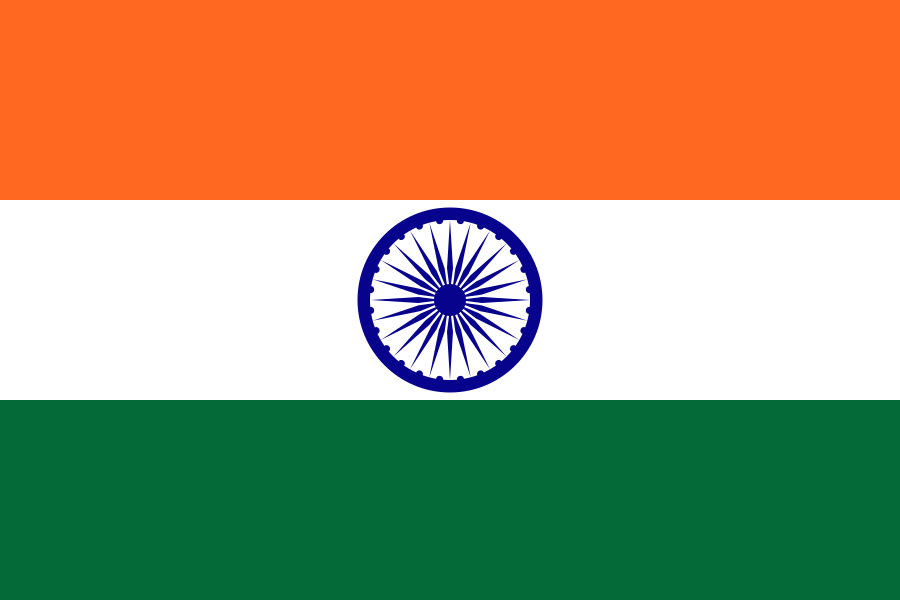
 India
Quick answerIndia is a country in Southern Asia, with a population of 1,464,000,000 (2025). Its capital is New Delhi, its official language is Hindi and English, and its currency is the Indian rupee (INR). It covers 3,287,263 square kilometres (1,269,219 square miles), and its time zone is Asia/Kolkata.
India is the world's most populous country, home to about 1.46 billion people in 2025. Its capital is New Delhi, its official languages are Hindi and English, and its currency is the rupee.
Key facts
| Capital | New Delhi |
|---|---|
| Population | 1,464,000,000 (2025) · 1464.0 million |
| Population density | 492.4 people per km² (land area) |
| Area | 3,287,263 km² (1,269,219 sq mi) total · 2,973,190 km² (1,147,955 sq mi) land |
| Official languages | Hindi (official), English (official) |
| Currency | Indian rupee (INR, ₹) |
| Time zone | Asia/Kolkata |
| Government | Federal parliamentary republic |
| Coastline | 7,517 km |
| Highest point | Kangchenjunga, 8,586 m |
| Life expectancy | 72 years (2023) |
| Calling code | +91 |
| Driving side | Left |
| Internet domain | .in |
Overview
India is a country in South Asia and the world's most populous, with about 1.464 billion people in 2025. It is the seventh-largest country by area, covering 3,287,263 square kilometres between the Himalayas in the north and the Indian Ocean in the south. India shares land borders with six countries — Pakistan, China, Nepal, Bhutan, Bangladesh and Myanmar — and its coastline runs for 7,517 kilometres along the Arabian Sea and the Bay of Bengal. In the far north stands Kangchenjunga, at 8,586 metres the country's highest point and the third-highest mountain in the world. The great rivers of the north, the Indus and the Ganges, water some of the most densely farmed plains on Earth, while the Deccan Plateau fills the south.
India's population has grown from 361 million in 1951 to about 1.464 billion in 2025, passing China as the world's most populous country in the early 2020s. It is a young country by world standards: the median age was about 29.8 years in 2024. Life expectancy at birth has risen from 49.7 years in 1970–75 to 72.0 years in 2023. Most Indians still live in towns and villages, but the cities are huge: the Delhi urban area had about 16.3 million people in 2011, and Mumbai's metropolitan region had more than 20 million. Hindi and English are the Union's official languages, and the Constitution recognises 22 scheduled languages.
India is a federal parliamentary republic. It became independent from Britain in 1947 and adopted its constitution in 1950. Its economy, worth about $3.9 trillion in 2024, was the world's fifth-largest that year, built on services, information technology, manufacturing and agriculture. India is a nuclear-weapon state and a founding member of the United Nations, and its cultural legacy includes 45 UNESCO World Heritage Sites, from the Taj Mahal to the temples of the south. Indian food, film, music and cricket are followed around the world.
Notable facts
- India's population was about 1.464 billion in 2025, making it the most populous country in the world.
- Kangchenjunga, at 8,586 metres on the India–Nepal border, is India's highest point and the third-highest mountain in the world.
- Life expectancy at birth in India rose from 49.7 years in 1970–75 to 72.0 years in 2023.
- New Delhi, the capital, is a municipality of about 250,000 people (2011) inside the Delhi megacity of about 16.8 million.
- India has 45 UNESCO World Heritage Sites, including the Taj Mahal.
How India compares
Comparison table — India next to 3 similar countries (neighbours first, then the same subregion).
| Country | Population | Area | Density | Capital |
|---|---|---|---|---|
| India ★ | 1,464,000,000 (2025) | 3,287,263 km² | 492.4 people per km² | New Delhi |
| Australia | 27,801,023 (2025) | 7,692,024 km² | 3.6 people per km² | Canberra |
| Brazil | 213,421,037 (2025) | 8,515,767 km² | 25.2 people per km² | Brasília |
| Canada | 41,798,407 (2026) | 9,984,670 km² | 4.6 people per km² | Ottawa |
Cities in India
- Mumbai 12,442,373 people (2011) Known for Bollywood
- Bengaluru 8,443,675 people (2011) Known for Information technology ('Silicon Valley of India')
- Chennai 6,748,026 people (2011) Known for Marina Beach
- New Delhi 249,998 people (2011) · Capital Known for Seat of India's government
Frequently asked questions
What is the capital of India?
The capital of India is New Delhi. It is the seat of all three branches of government: the President, Parliament and the Supreme Court. New Delhi is a small municipality of about 250,000 people (2011) inside the Delhi megacity, whose urban area had about 16.3 million people in 2011.
What is the population of India?
India had a population of about 1.464 billion in 2025, making it the most populous country in the world. The population has grown from 361 million in 1951, when the first post-independence census was taken. India passed China as the world's most populous country in the early 2020s.
What language is spoken in India?
Hindi and English are the official languages of India's Union government, and English is used widely in law, business and higher education. The Constitution also recognises 22 scheduled languages, including Bengali, Tamil, Telugu and Marathi, and hundreds of other languages are spoken across the country.
What currency is used in India?
India uses the rupee (INR, symbol ₹). It is divided into 100 paise. Cash is still common, but digital payments have grown fast: the UPI system now handles billions of transactions a month, and cards and phone payments work in most towns and cities.
Where is India?
India is in South Asia, between the Himalayas in the north and the Indian Ocean in the south. It shares land borders with Pakistan, China, Nepal, Bhutan, Bangladesh and Myanmar. The Arabian Sea lies to the south-west and the Bay of Bengal to the south-east.
What time zone is India in?
India uses Indian Standard Time (IST, UTC+5:30) across the whole country, and does not observe daylight saving. The IANA time zone name is Asia/Kolkata. India is five and a half hours ahead of Greenwich Mean Time, so noon in London is 5:30 p.m. the same day in New Delhi.
Quick quiz
Three questions from the facts on this page. No sign-up, no score is saved.
Keep exploring
- Mumbai — city in India
- Bengaluru — city in India
- Chennai — city in India
- New Delhi — capital of India
- Pakistan — neighbouring country (page coming soon)
- China — neighbouring country (page coming soon)
- Nepal — neighbouring country (page coming soon)
- Bhutan — neighbouring country (page coming soon)
- Bangladesh — neighbouring country (page coming soon)
- Myanmar — neighbouring country (page coming soon)
- Mahatma Gandhi — Indian politics figure
- All countries — the full list
Sources & last updated
- Wikipedia — India
- Wikipedia — Kangchenjunga
- Wikipedia — New Delhi
- Wikipedia — Delhi
- Wikipedia — List of countries by GDP (nominal)
- mledoze/countries (GitHub) — skeleton fields
Last updated: . Figures are shown with their year; where sources disagree, the value is left out rather than estimated.