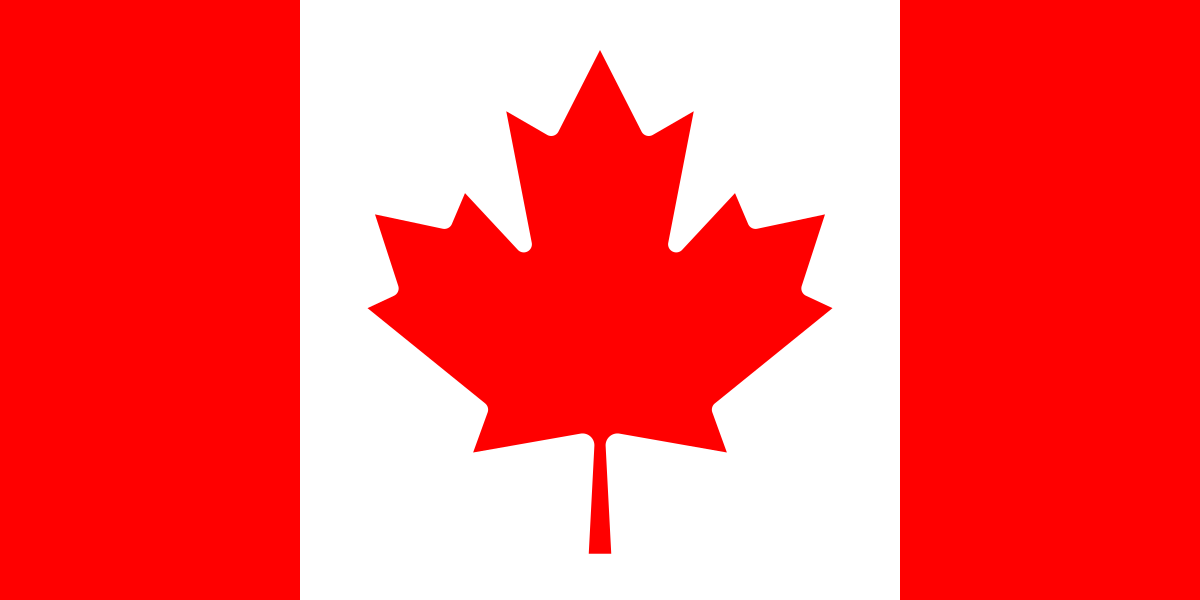
 Canada
Quick answerCanada is a country in North America, with a population of 41,798,407 (2026). Its capital is Ottawa, its official language is English and French, and its currency is the Canadian dollar (CAD). It covers 9,984,670 square kilometres (3,855,101 square miles), and its time zone is America/St_Johns.
Canada is the world's second-largest country by area, stretching from the Atlantic Ocean to the Pacific and north into the Arctic. About 41.8 million people lived there in mid-2026. Its capital is Ottawa, its largest city is Toronto, and it has two official languages, English and French.
Key facts
| Capital | Ottawa |
|---|---|
| Population | 41,798,407 (2026) · 41.8 million |
| Population density | 4.6 people per km² (land area) |
| Area | 9,984,670 km² (3,855,101 sq mi) total · 9,093,507 km² (3,511,021 sq mi) land |
| Official languages | English (official), French (official) |
| Currency | Canadian dollar (CAD, $) |
| Time zones | America/St_Johns, America/Halifax, America/Toronto, America/Winnipeg, America/Edmonton, America/Vancouver |
| Government | Federal parliamentary constitutional monarchy |
| Coastline | 202,080 km |
| Highest point | Mount Logan, 5,959 m |
| Life expectancy | 82.2 years (2024) |
| Calling code | +1 |
| Driving side | Right |
| Internet domain | .ca |
Overview
Canada covers 9,984,670 square kilometres, making it the second-largest country in the world by total area, behind only Russia. It stretches from the Atlantic Ocean in the east to the Pacific Ocean in the west and north into the Arctic Ocean, and it has the world's longest coastline. Its only land neighbour is the United States, with which it shares the world's longest land border, about 8,891 kilometres. Much of the country is forest, lakes and tundra, and Mount Logan in Yukon rises to 5,959 metres, the highest point in Canada. The Canadian Arctic archipelago, a maze of northern islands, is one of the least visited places on earth.
About 41.8 million people lived in Canada in the second quarter of 2026, according to Statistics Canada, making it one of the least densely populated large countries, at about 4.2 people per square kilometre. Most Canadians live in cities near the United States border: Toronto, the largest city, had about 2.8 million residents in 2021, followed by Montreal with about 1.8 million and Calgary with about 1.3 million. Canada has two official languages, English and French, and life expectancy at birth was 82.2 years in 2024.
Canada is a federal parliamentary constitutional monarchy. The monarch is head of state, represented by a governor general, while the prime minister leads the government. The country is made up of ten provinces and three territories, and it was formed by Confederation in 1867. Its economy, worth about $2.5 trillion in 2026 according to the International Monetary Fund, rests on natural resources, manufacturing and services. Canada is a member of the Commonwealth, the G7 and NATO, and it plays an active part in the United Nations. Canada is known for its winter sports, its national parks and its multicultural cities, and for landmarks such as the CN Tower in Toronto, the Rocky Mountains and Niagara Falls.
Notable facts
- Canada covers 9,984,670 square kilometres, making it the second-largest country in the world by total area.
- Canada has the world's longest coastline, at 202,080 kilometres according to the CIA World Factbook.
- Mount Logan, in Yukon, rises to 5,959 metres, the highest point in Canada and the second-highest peak in North America.
- Canada had a population of 41,798,407 in the second quarter of 2026, according to Statistics Canada.
- Life expectancy at birth in Canada was 82.2 years in 2024, according to Statistics Canada.
How Canada compares
Comparison table — Canada next to 3 similar countries (neighbours first, then the same subregion).
| Country | Population | Area | Density | Capital |
|---|---|---|---|---|
| Canada ★ | 41,798,407 (2026) | 9,984,670 km² | 4.6 people per km² | Ottawa |
| United States | 341,784,857 (2025) | 9,833,520 km² | 37.4 people per km² | Washington, D.C. |
| Australia | 27,801,023 (2025) | 7,692,024 km² | 3.6 people per km² | Canberra |
| Brazil | 213,421,037 (2025) | 8,515,767 km² | 25.2 people per km² | Brasília |
Cities in Canada
- Toronto 2,794,356 people (2021) Known for CN Tower
- Montreal 1,762,949 people (2021) Known for French language and culture
- Ottawa 1,017,449 people (2021) · Capital Known for Canada's Parliament
- Vancouver 662,248 people (2021) Known for Mountains and ocean setting
Frequently asked questions
What is the capital of Canada?
The capital of Canada is Ottawa, in Ontario, on the Ottawa River across from Gatineau in Quebec. About 1.02 million people lived in the city in 2021, and about 1.49 million in its metropolitan area. Ottawa became the capital in 1857, when Queen Victoria chose it as a compromise between Toronto and Montreal.
What is the population of Canada?
Canada had a population of 41,798,407 in the second quarter of 2026, according to Statistics Canada. It is one of the least densely populated large countries, at about 4.2 people per square kilometre, because most Canadians live in a narrow band of cities near the United States border.
What language is spoken in Canada?
Canada has two official languages, English and French. English is the first language of most Canadians, while French is the first language of about one in five, concentrated in Quebec. Federal government services are offered in both languages, and the province of Quebec is officially French-speaking.
What currency is used in Canada?
Canada uses the Canadian dollar (CAD, symbol $). The dollar is divided into 100 cents, and coins include the one-dollar loonie and the two-dollar toonie. The currency is issued by the Bank of Canada, and its value floats against the U.S. dollar and other major currencies.
Where is Canada?
Canada is in North America, north of the United States, stretching from the Atlantic Ocean in the east to the Pacific Ocean in the west and north into the Arctic Ocean. It is the world's second-largest country by area. Its only land neighbour is the United States, with which it shares the world's longest land border.
What time zone is Canada in?
Canada spans six time zones, from Newfoundland Time (UTC-3:30) in the east to Pacific Time (UTC-8) in the west. Toronto and Ottawa use Eastern Time (UTC-5), Vancouver uses Pacific Time, and most of the country observes daylight saving time from March to November, except parts of Saskatchewan and Yukon.
Quick quiz
Three questions from the facts on this page. No sign-up, no score is saved.
Keep exploring
- Toronto — city in Canada
- Montreal — city in Canada
- Ottawa — capital of Canada
- Vancouver — city in Canada
- United States — neighbouring country
- All countries — the full list
Sources & last updated
- Wikipedia — Canada
- Statistics Canada, Population estimates, quarterly
- Wikipedia — List of Canadian provinces and territories by life expectancy (Statistics Canada)
- Wikipedia — Mount Logan
- Wikipedia — Geography of Canada
Last updated: . Figures are shown with their year; where sources disagree, the value is left out rather than estimated.