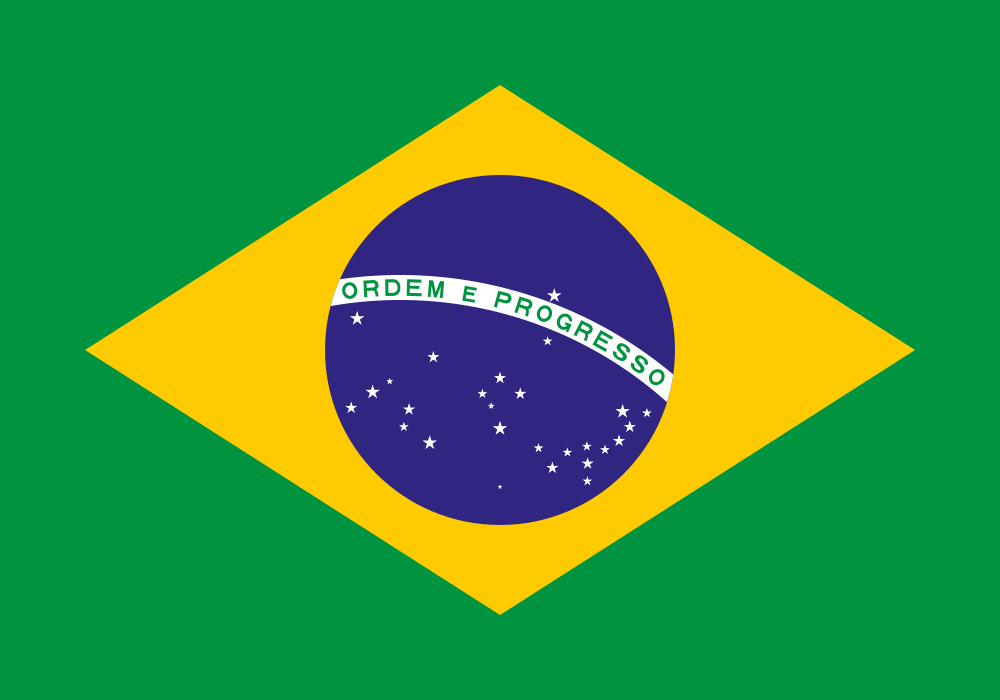
 Brazil
Quick answerBrazil is a country in South America, with a population of 213,421,037 (2025). Its capital is Brasília, its official language is Portuguese, and its currency is the Brazilian real (BRL). It covers 8,515,767 square kilometres (3,287,955 square miles), and its time zone is America/Rio_Branco.
Brazil is the largest country in South America, home to about 213 million people. Its capital is Brasília, its official language is Portuguese, and its currency is the Brazilian real.
Key facts
| Capital | Brasília |
|---|---|
| Population | 213,421,037 (2025) · 213.4 million |
| Population density | 25.2 people per km² (land area) |
| Area | 8,515,767 km² (3,287,955 sq mi) total · 8,460,415 km² (3,266,583 sq mi) land |
| Official language | Portuguese (official) |
| Currency | Brazilian real (BRL, R$) |
| Time zones | America/Rio_Branco, America/Manaus, America/Sao_Paulo, America/Noronha |
| Government | Federal presidential republic |
| Coastline | 7,491 km |
| Highest point | Pico da Neblina, 2,994 m |
| Life expectancy | 76 years (2024) |
| Calling code | +55 |
| Driving side | Right |
| Internet domain | .br |
Overview
Brazil covers roughly half of South America, stretching from the Atlantic coast in the east to the Amazon rainforest in the west. It borders nine countries — every South American country except Chile and Ecuador — plus French Guiana. Brazil covers 8,515,767 square kilometres, making it the fifth-largest country in the world. Its landscapes range from the Amazon basin, which holds the world's largest rainforest and river system, to the dry interior of the north-east, the high central plateau where Brasília stands, and the long Atlantic coastline of 7,491 kilometres. The highest point is Pico da Neblina, at 2,994 metres on the border with Venezuela.
About 213.4 million people lived in Brazil in mid-2025, according to the Brazilian Institute of Geography and Statistics (IBGE), making it the most populous country in South America and the seventh most populous in the world. About 88 per cent of Brazilians live in cities and towns. São Paulo, the largest city, anchors a metropolitan area of more than 21 million people, while Rio de Janeiro anchors one of about 14 million. Portuguese is the official language, and life expectancy at birth was 76.0 years in 2024.
Brazil is a federal presidential republic made up of 26 states and a federal district. The president is both head of state and head of government. The country became independent from Portugal in 1822 and a republic in 1889. Its economy, worth about $2.2 trillion in 2024, is the largest in Latin America, built on agriculture, mining, manufacturing and services — Brazil is a leading exporter of soybeans, coffee, sugar, iron ore and beef. Brazil is known for its music and dance, from samba and bossa nova to carnival in Rio de Janeiro, for football, and for the Amazon rainforest, which holds about a tenth of the world's known species.
Notable facts
- Brazil is the fifth-largest country in the world by area, covering 8,515,767 square kilometres — roughly half of South America.
- Brazil's population was 213,421,037 on 1 July 2025, according to IBGE, making it the seventh most populous country in the world.
- The Amazon rainforest, most of which lies in Brazil, is the world's largest rainforest and is home to about a tenth of the world's known species.
- Pico da Neblina, at 2,994 metres on the border with Venezuela, is the highest point in Brazil.
- Brasília, the capital, was built from scratch in the late 1950s and inaugurated in 1960; Rio de Janeiro was the capital before it.
How Brazil compares
Comparison table — Brazil next to 3 similar countries (neighbours first, then the same subregion).
| Country | Population | Area | Density | Capital |
|---|---|---|---|---|
| Brazil ★ | 213,421,037 (2025) | 8,515,767 km² | 25.2 people per km² | Brasília |
| Australia | 27,801,023 (2025) | 7,692,024 km² | 3.6 people per km² | Canberra |
| Canada | 41,798,407 (2026) | 9,984,670 km² | 4.6 people per km² | Ottawa |
| Egypt | 120,101,175 (2026) | 1,010,408 km² | 120.7 people per km² | Cairo |
Cities in Brazil
- São Paulo 11,904,961 people (2025) Known for Avenida Paulista
- Rio de Janeiro 6,730,729 people (2025) Known for Copacabana Beach
- Brasília 2,996,899 people (2025) · Capital Known for Modernist architecture
- Salvador 2,564,204 people (2025) Known for Pelourinho
Frequently asked questions
What is the capital of Brazil?
The capital of Brazil is Brasília. It was built from scratch in the late 1950s and inaugurated in 1960, replacing Rio de Janeiro as the capital. Brasília had about 3.0 million people in 2025 and stands on the central Brazilian plateau, about 1,170 metres above sea level. Its modernist buildings were designed by Oscar Niemeyer.
What is the population of Brazil?
Brazil had a population of 213,421,037 on 1 July 2025, according to the Brazilian Institute of Geography and Statistics (IBGE). That makes it the most populous country in South America and the seventh most populous in the world. About 88 per cent of Brazilians live in cities and towns.
What language is spoken in Brazil?
Portuguese is the official language of Brazil and is spoken by almost everyone in the country. Brazilian Portuguese differs from European Portuguese in pronunciation and some vocabulary. More than 200 indigenous languages are also spoken, mainly in the Amazon region, along with languages brought by immigrant communities.
What currency is used in Brazil?
Brazil uses the Brazilian real (BRL, symbol R$). The real was introduced in 1994 as part of the Plano Real, which ended a period of very high inflation. It replaced the cruzeiro real. Banknotes and coins are issued by the Central Bank of Brazil.
Where is Brazil?
Brazil is in eastern South America, between the Atlantic Ocean and the Andes. It borders nine countries — Argentina, Bolivia, Colombia, Guyana, Paraguay, Peru, Suriname, Uruguay and Venezuela — plus French Guiana. It covers roughly half of the South American continent and spans four time zones.
What time zone is Brazil in?
Brazil spans four time zones, from UTC−5 in the far west state of Acre to UTC−2 on the Atlantic islands of Fernando de Noronha. Most of the country, including São Paulo, Rio de Janeiro and Brasília, uses UTC−3. Brazil has not observed daylight saving time since 2019.
Quick quiz
Three questions from the facts on this page. No sign-up, no score is saved.
Keep exploring
- São Paulo — city in Brazil
- Rio de Janeiro — city in Brazil
- Brasília — capital of Brazil
- Salvador — city in Brazil
- Argentina — neighbouring country (page coming soon)
- Bolivia — neighbouring country (page coming soon)
- Colombia — neighbouring country (page coming soon)
- Guyana — neighbouring country (page coming soon)
- Paraguay — neighbouring country (page coming soon)
- Peru — neighbouring country (page coming soon)
- Suriname — neighbouring country (page coming soon)
- Uruguay — neighbouring country (page coming soon)
- Venezuela — neighbouring country (page coming soon)
- All countries — the full list
Sources & last updated
- Wikipedia — Brazil
- IBGE News Agency — Population estimates 2025
- World Bank, World Development Indicators
- mledoze/countries (skeleton: area, borders, capital, languages, currency, demonym, calling code, landlocked, coordinates, region, tld)
- Wikipedia — List of countries by length of coastline
- Wikipedia — List of countries and dependencies by area
- Destatis — GDP key table (IMF World Economic Outlook)
Last updated: . Figures are shown with their year; where sources disagree, the value is left out rather than estimated.