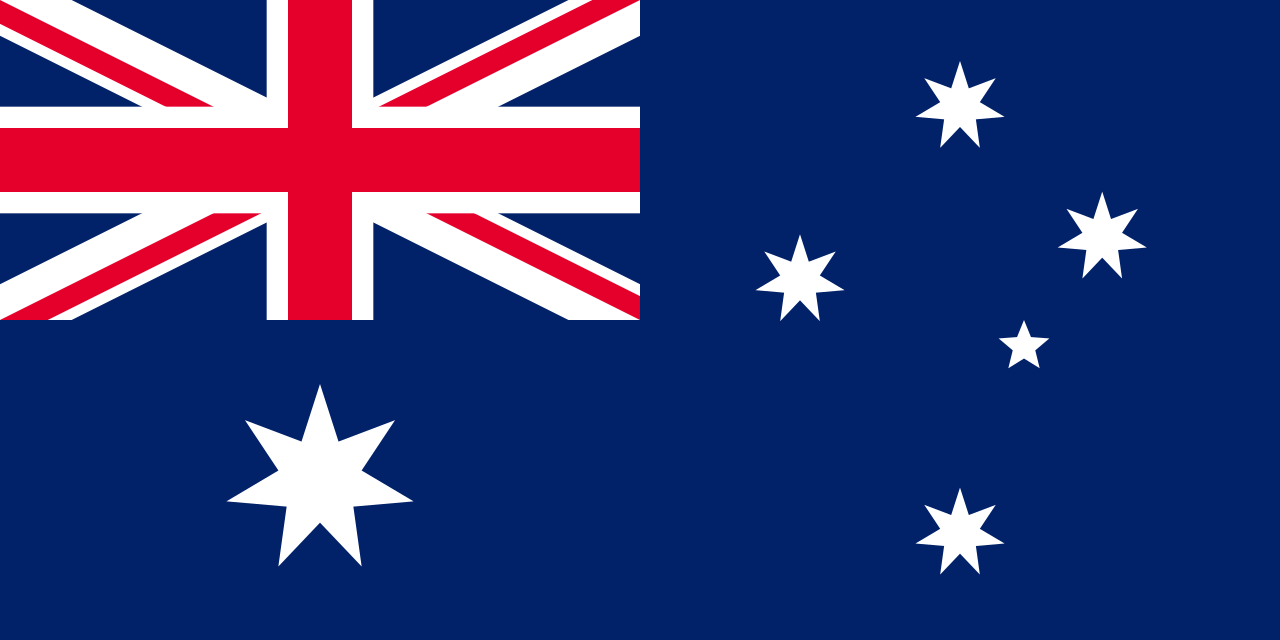
 Australia
Quick answerAustralia is a country in Australia and New Zealand, with a population of 27,801,023 (2025). Its capital is Canberra, its official language is English, and its currency is the Australian dollar (AUD). It covers 7,692,024 square kilometres (2,969,906 square miles), and its time zone is Australia/Perth.
Australia is the world's smallest continent and sixth-largest country, home to about 27.8 million people. Its capital is Canberra, its national language is English, and its currency is the Australian dollar.
Key facts
| Capital | Canberra |
|---|---|
| Population | 27,801,023 (2025) · 27.8 million |
| Population density | 3.6 people per km² (land area) |
| Area | 7,692,024 km² (2,969,906 sq mi) total · 7,688,287 km² (2,968,463 sq mi) land |
| Official language | English (official) |
| Currency | Australian dollar (AUD, $) |
| Time zones | Australia/Perth, Australia/Darwin, Australia/Adelaide, Australia/Brisbane, Australia/Sydney, Australia/Melbourne, Australia/Hobart, Australia/Canberra |
| Government | Federal parliamentary constitutional monarchy |
| Coastline | 35,877 km |
| Highest point | Mount Kosciuszko, 2,228 m |
| Calling code | +61 |
| Driving side | Left |
| Internet domain | .au |
Overview
Australia is a country in Oceania, covering the mainland of the Australian continent, the island of Tasmania and many smaller islands. With a land area of 7,688,287 square kilometres, it is the sixth-largest country in the world and the world's smallest continent. It is also the flattest and driest inhabited continent: deserts fill much of the centre, while rainforests and farmland line the wetter coasts. The Great Dividing Range runs down the east, where Mount Kosciuszko rises to 2,228 metres, the highest point on the mainland. Australia has 35,877 kilometres of coastline, not counting offshore islands, and no land borders at all.
Australia had a population of 27,801,023 in December 2025, according to the Australian Bureau of Statistics. It is one of the most urbanised countries in the world: most people live in cities on the eastern seaboard, above all Sydney and Melbourne, each with more than five million people in its wider metropolitan area. Aboriginal Australians arrived from South-East Asia 50,000 to 65,000 years ago, and by the time of British settlement they spoke more than 250 distinct languages — one of the oldest living cultures in the world. In 2020, 29.8% of Australians were born overseas, one of the highest shares of any country.
Australia is a federal parliamentary constitutional monarchy. The six former British colonies federated in 1901 to form the Commonwealth of Australia, which today has six states and ten territories. The King of Australia is head of state, represented by a governor-general, and the prime minister leads the government. Its economy, worth about $1.8 trillion in 2024, is one of the most developed in the world, built on natural resources, services and trade with Asia, and Australians enjoy one of the highest per-capita incomes on Earth. The country is known for its wildlife, its beaches and the outback, and for sport, from cricket to the Australian Open.
Notable facts
- Australia's land area is 7,688,287 square kilometres, making it the sixth-largest country in the world.
- Australia has no land neighbours: it is the only country that occupies an entire continent.
- Canberra, the capital, had about 484,630 people in June 2025 — far fewer than Sydney (5,638,830) or Melbourne (5,435,590) by the wider metropolitan measure.
- By urban area, Melbourne (5,328,274) passed Sydney (5,219,674) as Australia's largest city in June 2025.
- Aboriginal Australians arrived from South-East Asia 50,000 to 65,000 years ago, one of the oldest living cultures in the world.
How Australia compares
Comparison table — Australia next to 3 similar countries (neighbours first, then the same subregion).
| Country | Population | Area | Density | Capital |
|---|---|---|---|---|
| Australia ★ | 27,801,023 (2025) | 7,692,024 km² | 3.6 people per km² | Canberra |
| New Zealand | 5,324,700 (2025) | 268,838 km² | 19.9 people per km² | Wellington |
| Brazil | 213,421,037 (2025) | 8,515,767 km² | 25.2 people per km² | Brasília |
| Canada | 41,798,407 (2026) | 9,984,670 km² | 4.6 people per km² | Ottawa |
Cities in Australia
See all 4 cities in Australia →
- Melbourne 5,328,274 people (2025) Known for Laneways and street art
- Sydney 5,219,674 people (2025) Known for Sydney Opera House
- Brisbane 2,745,086 people (2025) Known for Brisbane River
- Canberra 484,630 people (2025) · Capital Known for Parliament House
Frequently asked questions
What is the capital of Australia?
The capital of Australia is Canberra, not Sydney. It was built as a compromise between Sydney and Melbourne, Australia's two largest cities, after the colonies federated in 1901. Canberra has about 484,630 people (June 2025) and is home to Parliament House and the national government.
What is the population of Australia?
Australia had a population of 27,801,023 in December 2025, according to the Australian Bureau of Statistics. It is the world's 54th most populous country, but one of the most urbanised: most Australians live in cities on the eastern seaboard, led by Sydney and Melbourne.
What language is spoken in Australia?
English is the de facto national language of Australia, used in government, schools and the media, although it has no official status in law. Hundreds of other languages are spoken, including community languages brought by migrants and Aboriginal languages, some of which are being revived.
What currency is used in Australia?
Australia uses the Australian dollar (AUD, symbol $). It was introduced in 1966, replacing the Australian pound, and Australia was the first country to issue polymer banknotes. The dollar is also used in several Pacific island nations, including Kiribati and Tuvalu.
Where is Australia?
Australia is in Oceania, between the Indian Ocean and the Pacific Ocean, south-east of Asia. It covers the mainland of the Australian continent plus the island of Tasmania and smaller islands. It is the only country that occupies a whole continent, and it has no land borders at all.
What time zone is Australia in?
Australia has three main time zones: Western Standard Time (UTC+8), Central Standard Time (UTC+9:30) and Eastern Standard Time (UTC+10). The south-east observes daylight saving in summer, but Queensland, Western Australia and the Northern Territory do not. Sydney and Melbourne use the Australia/Sydney and Australia/Melbourne zones.
Quick quiz
Three questions from the facts on this page. No sign-up, no score is saved.
Keep exploring
- Melbourne — city in Australia
- Sydney — city in Australia
- Brisbane — city in Australia
- Canberra — capital of Australia
- New Zealand — another country in Australia and New Zealand
- All countries — the full list
Sources & last updated
- Wikipedia — Australia
- Wikipedia — Mount Kosciuszko
- Wikipedia — List of cities in Australia by population
- Wikipedia — List of countries by GDP (nominal)
- mledoze/countries (GitHub) — skeleton fields
Last updated: . Figures are shown with their year; where sources disagree, the value is left out rather than estimated.