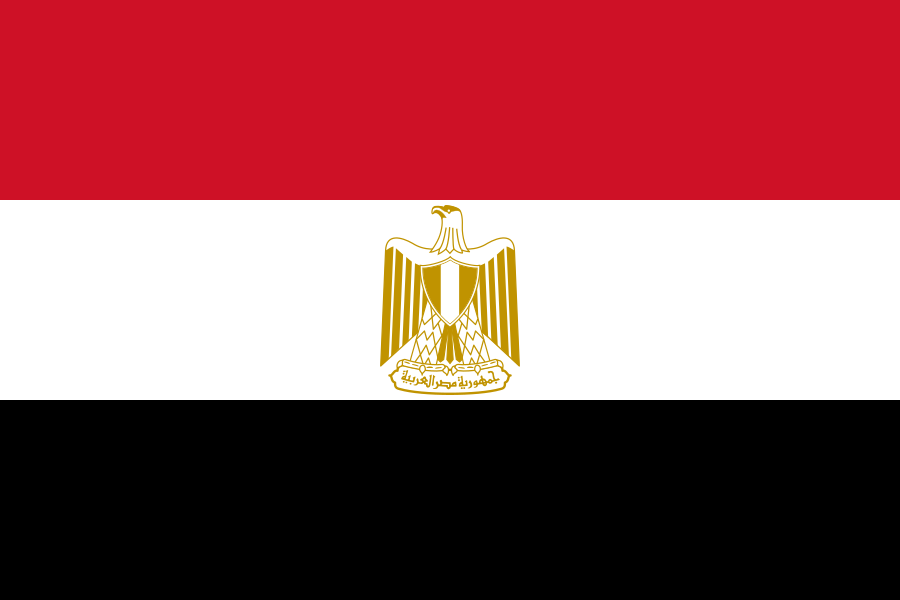
 Egypt
Quick answerEgypt is a country in Northern Africa, with a population of 120,101,175 (2026). Its capital is Cairo, its official language is Arabic, and its currency is the Egyptian pound (EGP). It covers 1,010,408 square kilometres (390,121 square miles), and its time zone is Africa/Cairo.
Egypt is the most populous country in the Arab world, home to about 120 million people. Its capital is Cairo, its official language is Arabic, and its currency is the Egyptian pound.
Key facts
| Capital | Cairo |
|---|---|
| Population | 120,101,175 (2026) · 120.1 million |
| Population density | 120.7 people per km² (land area) |
| Area | 1,010,408 km² (390,121 sq mi) total · 995,450 km² (384,345 sq mi) land |
| Official language | Arabic (official) |
| Currency | Egyptian pound (EGP, £) |
| Time zone | Africa/Cairo |
| Government | Unitary semi-presidential republic |
| Coastline | 2,450 km |
| Highest point | Mount Catherine, 2,629 m |
| Life expectancy | 71.8 years (2024) |
| Calling code | +20 |
| Driving side | Right |
| Internet domain | .eg |
Overview
Egypt sits in the north-east corner of Africa, where the Mediterranean Sea meets the Red Sea. It borders Libya to the west, Sudan to the south and Israel and the Gaza Strip to the north-east, and it covers 1,010,408 square kilometres, making it one of Africa's largest countries. The Nile, the world's longest river, runs the length of the country and has shaped almost everything about it: nearly all Egyptians live in the narrow Nile Valley and the Delta, while the Western Desert, the Eastern Desert and the Sinai Peninsula are almost empty. Egypt's 2,450 kilometres of coastline run along the Mediterranean in the north and the Red Sea in the east, and its highest point is Mount Catherine, at 2,629 metres in southern Sinai.
About 120.1 million people lived in Egypt in 2026, making it the most populous country in the Arab world and the third most populous in Africa. About 43 per cent of Egyptians live in towns and cities, and the capital, Cairo, anchors a metropolitan area of more than 22 million people, one of the largest in the world. Arabic is the official language, and Egyptian Arabic is what people speak day to day. Life expectancy at birth was 71.8 years in 2024. Most Egyptians are Muslim, with a large Coptic Christian minority, and the country has been a crossroads of Africa, Asia and Europe for thousands of years.
Egypt is a unitary semi-presidential republic. Its ancient civilisation built the pyramids of Giza around 2560 BC, and the Great Pyramid is the only one of the Seven Wonders of the Ancient World still standing. Egypt has seven UNESCO World Heritage sites, from the temples of Luxor to the monasteries of Sinai. The Suez Canal, opened in 1869, still links the Mediterranean with the Red Sea and carries a large share of world trade. Tourism, farming along the Nile, manufacturing and the canal are the mainstays of the economy, and the Grand Egyptian Museum, opened in 2025 beside the pyramids, is the newest draw for visitors.
Notable facts
- Egypt's population reached 120,101,175 in 2026, according to Statista — the largest of any Arab country.
- The Great Pyramid of Giza, built around 2560 BC, is the only one of the Seven Wonders of the Ancient World still standing.
- The Nile, at about 6,650 kilometres, is the longest river in the world, and almost all Egyptians live along it.
- Egypt has seven UNESCO World Heritage sites, including Ancient Thebes, Historic Cairo and the Saint Catherine Area.
- Life expectancy at birth in Egypt was 71.8 years in 2024, according to the World Bank.
How Egypt compares
Comparison table — Egypt next to 3 similar countries (neighbours first, then the same subregion).
| Country | Population | Area | Density | Capital |
|---|---|---|---|---|
| Egypt ★ | 120,101,175 (2026) | 1,010,408 km² | 120.7 people per km² | Cairo |
| Australia | 27,801,023 (2025) | 7,692,024 km² | 3.6 people per km² | Canberra |
| Brazil | 213,421,037 (2025) | 8,515,767 km² | 25.2 people per km² | Brasília |
| Canada | 41,798,407 (2026) | 9,984,670 km² | 4.6 people per km² | Ottawa |
Cities in Egypt
- Cairo 9,801,536 people (2023) · Capital Known for Egyptian Museum
- Alexandria 5,362,517 people (2024) Known for Bibliotheca Alexandrina
- Giza 4,458,135 people (2023) Known for Great Pyramid of Giza
- Luxor 284,952 people (2023) Known for Karnak Temple
Frequently asked questions
What is the capital of Egypt?
The capital of Egypt is Cairo. It is also the country's largest city, with about 9.8 million people inside the city limits (2023) and about 22.2 million in the wider Greater Cairo area. Cairo sits on the east bank of the Nile in northern Egypt and is home to the Egyptian Museum, the Citadel and the old Islamic city.
What is the population of Egypt?
Egypt had a population of 120,101,175 in 2026, according to Statista, making it the most populous country in the Arab world and the third most populous in Africa, after Nigeria and Ethiopia. Most Egyptians live along the Nile Valley and in the Delta, and about 43 per cent live in towns and cities.
What language is spoken in Egypt?
Arabic is the official language of Egypt, and Egyptian Arabic is the dialect almost everyone speaks day to day. English is widely understood in tourism, business and higher education, and French is taught in some schools. The ancient Egyptian language, written in hieroglyphs, died out centuries ago.
What currency is used in Egypt?
Egypt uses the Egyptian pound (EGP, symbol £). Cash is still common in markets and small shops, but cards are accepted in hotels, restaurants and larger stores in the cities. Visitors usually change money at banks or official exchange offices, and ATMs are easy to find in Cairo and Alexandria.
Where is Egypt?
Egypt is in north-eastern Africa, on the Mediterranean Sea to the north and the Red Sea to the east. It borders Libya to the west, Sudan to the south and Israel to the north-east, with the Gaza Strip beside it. The Sinai Peninsula, east of the Suez Canal, is the only part of Egypt in Asia.
What time zone is Egypt in?
Egypt uses Eastern European Time (EET, UTC+2) in winter and Eastern European Summer Time (UTC+3) in summer. Daylight saving was reintroduced in 2023, with clocks going forward on the last Friday in April and back on the last Thursday in October. The IANA time zone name is Africa/Cairo.
Quick quiz
Three questions from the facts on this page. No sign-up, no score is saved.
Keep exploring
- Cairo — capital of Egypt
- Alexandria — city in Egypt
- Giza — city in Egypt
- Luxor — city in Egypt
- Libya — neighbouring country (page coming soon)
- Sudan — neighbouring country (page coming soon)
- Israel — neighbouring country (page coming soon)
- Cleopatra — Egyptian politics figure
- All countries — the full list
Sources & last updated
- Wikipedia — Egypt
- Statista — Africa: most populated countries 2026
- World Bank, World Development Indicators
- mledoze/countries (skeleton: area, borders, capital, languages, currency, demonym, calling code, landlocked, coordinates, region, tld)
- Wikipedia — List of countries and dependencies by length of coastline
- Wikipedia — List of World Heritage Sites in Egypt
- Wikipedia — Mount Catherine
- Central Agency for Public Mobilization and Statistics (CAPMAS)
Last updated: . Figures are shown with their year; where sources disagree, the value is left out rather than estimated.