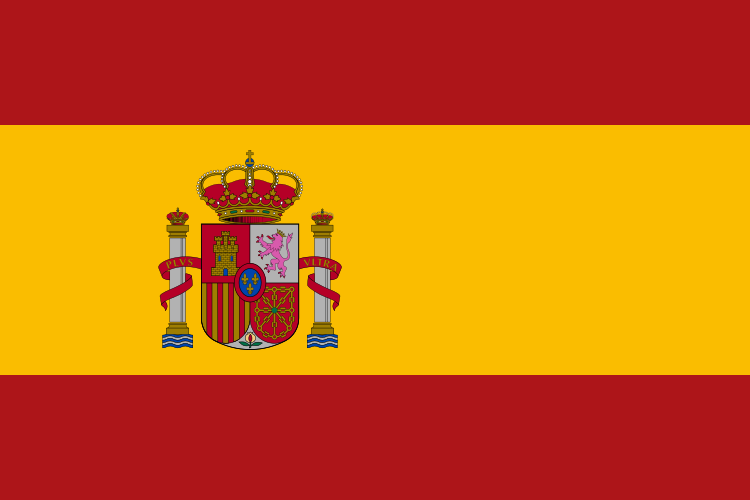
 Spain
Quick answerSpain is a country in Southern Europe, with a population of 49,801,559 (2026). Its capital is Madrid, its official language is Spanish, and its currency is the Euro (EUR). It covers 505,992 square kilometres (195,365 square miles), and its time zone is Europe/Madrid.
Spain is the fourth-largest country in Europe, home to about 49.8 million people. Its capital is Madrid, its official language is Spanish, and its currency is the euro.
Key facts
| Capital | Madrid |
|---|---|
| Population | 49,801,559 (2026) · 49.8 million |
| Population density | 99.8 people per km² (land area) |
| Area | 505,992 km² (195,365 sq mi) total · 498,980 km² (192,657 sq mi) land |
| Official language | Spanish (official) |
| Currency | Euro (EUR, €) |
| Time zones | Europe/Madrid, Atlantic/Canary |
| Government | Unitary parliamentary constitutional monarchy |
| Coastline | 4,964 km |
| Highest point | Mount Teide, 3,715 m |
| Life expectancy | 83.9 years (2024) |
| Calling code | +34 |
| Driving side | Right |
| Internet domain | .es |
Overview
Spain occupies most of the Iberian Peninsula in south-western Europe, between the Atlantic Ocean and the Mediterranean Sea. It borders France and Andorra to the north, Portugal to the west, and Morocco and Gibraltar to the south, across the Strait of Gibraltar. Spain covers 505,992 square kilometres, making it the fourth-largest country in Europe, and its 4,964 kilometres of coastline include the Balearic Islands in the Mediterranean and the Canary Islands in the Atlantic. The interior is a high central plateau, the Meseta, ringed by mountains, and the highest point in the country is Mount Teide, a volcano on Tenerife that rises to 3,715 metres.
About 49.8 million people lived in Spain in mid-2026, according to the National Statistics Institute (INE), a record high driven by immigration. Most Spaniards live in cities and towns: about 80 per cent of the population is urban. Madrid, the capital, anchors a metropolitan area of more than six million people, while Barcelona, on the Mediterranean coast, anchors one of more than five million. Spanish, also called Castilian, is the official language of the whole country, and Catalan, Galician and Basque are co-official in their regions. Life expectancy at birth was 83.9 years in 2024, among the highest in the world.
Spain is a unitary parliamentary constitutional monarchy. The king is head of state, and the prime minister heads the government. The country is divided into 17 autonomous communities with their own governments, from Catalonia and the Basque Country to Andalusia and Galicia. Spain joined the European Union in 1986 and is a member of NATO. Its economy, worth about $1.7 trillion in 2024, is the fourth largest in the eurozone, built on services, tourism, manufacturing and agriculture. Spain is known for its food and wine, its art — from Velázquez and Goya to Picasso and Dalí — its flamenco and festivals, and its football. It has 50 UNESCO World Heritage sites, including the Alhambra in Granada, the Sagrada Família in Barcelona and the historic centre of Toledo.
Notable facts
- Spain's population reached 49,801,559 on 1 July 2026, according to INE — a record high.
- Mount Teide, a volcano on Tenerife in the Canary Islands, is the highest point in Spain at 3,715 metres.
- Spain has 50 UNESCO World Heritage sites, the fifth-highest number of any country in the world.
- Spain shares a land border with Morocco at its North African enclaves of Ceuta and Melilla.
- Life expectancy at birth in Spain was 83.9 years in 2024, according to the World Bank, among the highest in the world.
How Spain compares
Comparison table — Spain next to 3 similar countries (neighbours first, then the same subregion).
| Country | Population | Area | Density | Capital |
|---|---|---|---|---|
| Spain ★ | 49,801,559 (2026) | 505,992 km² | 99.8 people per km² | Madrid |
| France | 68,720,337 (2025) | 551,695 km² | 126.3 people per km² | Paris |
| Australia | 27,801,023 (2025) | 7,692,024 km² | 3.6 people per km² | Canberra |
| Brazil | 213,421,037 (2025) | 8,515,767 km² | 25.2 people per km² | Brasília |
Cities in Spain
- Madrid 3,477,497 people (2025) · Capital Known for Royal Palace
- Barcelona 1,713,247 people (2025) Known for Sagrada Família
- Valencia 841,558 people (2025) Known for Paella
- Seville 688,714 people (2025) Known for Alcázar
Frequently asked questions
What is the capital of Spain?
The capital of Spain is Madrid. It is also the country's largest city, with about 3.5 million people inside the city limits (2025) and about 6.1 million in the wider metropolitan area. Madrid sits on a high plateau in the centre of Spain and is home to the Royal Palace, the Prado Museum and the Plaza Mayor.
What is the population of Spain?
Spain had a population of 49,801,559 on 1 July 2026, according to the National Statistics Institute (INE), a record high. That makes it the fourth most populous country in the European Union. Most Spaniards live in cities and towns, with the largest urban areas around Madrid, Barcelona and Valencia.
What language is spoken in Spain?
Spanish, also called Castilian, is the official language of Spain and is spoken by almost everyone in the country. Catalan, Galician and Basque are co-official languages in their regions — Catalonia, Galicia and the Basque Country — and Aranese is co-official in a small valley in the Pyrenees.
What currency is used in Spain?
Spain uses the euro (EUR, symbol €). Spain adopted the euro in 1999 for electronic payments and in 2002 for cash, replacing the Spanish peseta. The euro is shared by 20 European Union countries, so the same currency works across much of Europe.
Where is Spain?
Spain is in south-western Europe, on the Iberian Peninsula between the Atlantic Ocean and the Mediterranean Sea. It borders France and Andorra to the north and Portugal to the west, and it meets Morocco at its North African enclaves of Ceuta and Melilla. The Balearic Islands lie in the Mediterranean and the Canary Islands in the Atlantic.
What time zone is Spain in?
Most of Spain uses Central European Time (CET, UTC+1) in winter and Central European Summer Time (CEST, UTC+2) from the last Sunday in March to the last Sunday in October. The Canary Islands use Western European Time (UTC+0), one hour behind the mainland. The IANA time zone names are Europe/Madrid and Atlantic/Canary.
Quick quiz
Three questions from the facts on this page. No sign-up, no score is saved.
Keep exploring
- Madrid — capital of Spain
- Barcelona — city in Spain
- Valencia — city in Spain
- Seville — city in Spain
- Andorra — neighbouring country (page coming soon)
- France — neighbouring country
- Portugal — neighbouring country (page coming soon)
- Morocco — neighbouring country (page coming soon)
- All countries — the full list
Sources & last updated
- Wikipedia — Spain
- Instituto Nacional de Estadística (INE) — Continuous Population Statistics
- Instituto Nacional de Estadística (INE) — Vital Statistics, life expectancy 2024
- World Bank, World Development Indicators
- mledoze/countries (skeleton: area, borders, capital, languages, currency, demonym, calling code, landlocked, coordinates, region, tld)
- Wikipedia — List of countries by length of coastline
- Wikipedia — List of countries and dependencies by area
- Wikipedia — List of World Heritage Sites in Spain
- Destatis — GDP key table (IMF World Economic Outlook)
Last updated: . Figures are shown with their year; where sources disagree, the value is left out rather than estimated.