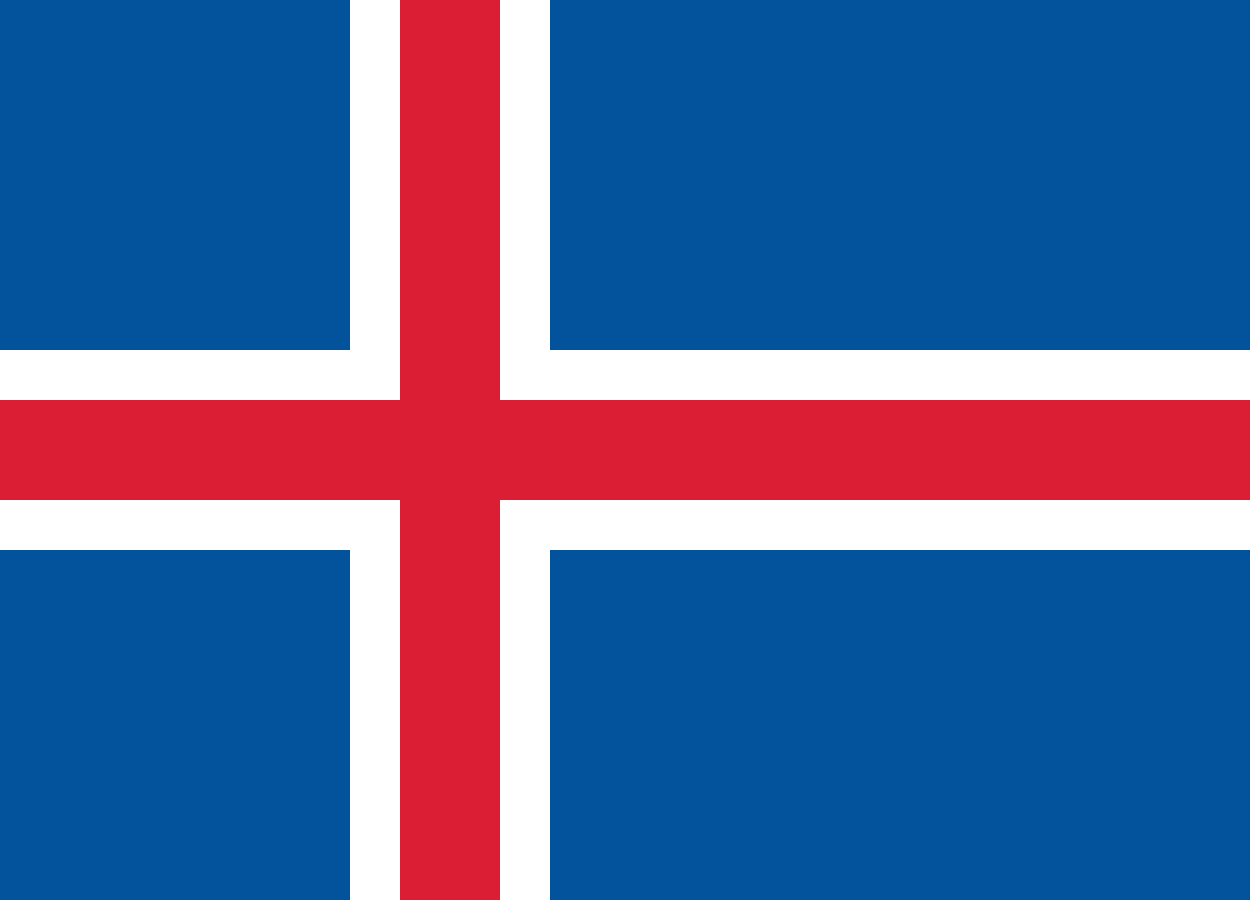
 Iceland
Quick answerIceland is a country in Northern Europe, with a population of 392,404 (2025). Its capital is Reykjavík, its official language is Icelandic, and its currency is the Icelandic króna (ISK). It covers 103,000 square kilometres (39,769 square miles), and its time zone is Atlantic/Reykjavik.
Iceland is a Nordic island country in the North Atlantic, home to about 392,000 people. Its capital and largest city is Reykjavík, its official language is Icelandic, and its currency is the Icelandic króna.
Key facts
| Capital | Reykjavík |
|---|---|
| Population | 392,404 (2025) · 0.4 million |
| Population density | 3.9 people per km² (land area) |
| Area | 103,000 km² (39,769 sq mi) total · 100,250 km² (38,707 sq mi) land |
| Official language | Icelandic (official) |
| Currency | Icelandic króna (ISK, kr) |
| Time zone | Atlantic/Reykjavik |
| Government | Unitary parliamentary republic |
| Coastline | 4,970 km |
| Highest point | Hvannadalshnúkur, 2,110 m |
| Life expectancy | 82.8 years (2024) |
| Calling code | +354 |
| Driving side | Right |
| Internet domain | .is |
Overview
Iceland is a Nordic island country in the North Atlantic Ocean, between Greenland and Norway, just south of the Arctic Circle. It sits on the Mid-Atlantic Ridge, the boundary between the North American and Eurasian tectonic plates, and its volcanic activity — geysers, hot springs and frequent eruptions — comes from that rift. The island covers 103,000 square kilometres, with a coastline of 4,970 kilometres cut by many fjords, and around a tenth of its land is covered by glaciers. The largest ice cap, Vatnajökull, holds the country's highest point, Hvannadalshnúkur, at 2,110 metres.
About 392,000 people lived in Iceland in 2025, according to the World Bank, making it the most sparsely populated country in Europe, with fewer than four people per square kilometre. About 94 per cent of Icelanders live in towns, and roughly two-thirds of the population live in the Capital Region around Reykjavík, the capital and largest city. Icelandic is the official language, and life expectancy at birth was 82.8 years in 2024. The Gulf Stream warms the island, so despite its high latitude Iceland has a temperate climate, with cool summers and mild winters for its latitude.
Settlement began in 874, when the Norwegian chieftain Ingólfur Arnarson built his homestead at what is now Reykjavík, and the Althing, founded in 930, is one of the world's oldest functioning parliaments. After centuries under Norwegian and then Danish rule, Iceland became a republic in 1944. It is a unitary parliamentary republic and a member of NATO, though it has no standing army. Its economy, worth about $35 billion in 2025, was built on fishing and now also rests on tourism, aluminium smelting powered by geothermal and hydroelectric energy, and biotechnology. Iceland has three UNESCO World Heritage sites: Þingvellir National Park, the volcanic island of Surtsey and Vatnajökull National Park.
Notable facts
- Iceland had a population of 392,404 in 2025, according to the World Bank — one of the smallest populations of any country in Europe.
- Hvannadalshnúkur, the 2,110-metre summit of the Öræfajökull volcano under the Vatnajökull glacier, is the highest point in Iceland.
- Iceland's parliament, the Althing, was founded in 930, making it one of the world's oldest functioning legislative assemblies.
- Iceland has no standing army — it is the only NATO member without one, protected only by a lightly armed coast guard.
- Iceland has three UNESCO World Heritage sites: Þingvellir National Park (2004), the volcanic island of Surtsey (2008) and Vatnajökull National Park (2019).
How Iceland compares
Comparison table — Iceland next to 3 similar countries (neighbours first, then the same subregion).
| Country | Population | Area | Density | Capital |
|---|---|---|---|---|
| Iceland ★ | 392,404 (2025) | 103,000 km² | 3.9 people per km² | Reykjavík |
| Norway | 5,633,770 (2026) | 323,802 km² | 18.5 people per km² | Oslo |
| United Kingdom | 69,483,939 (2025) | 244,376 km² | 286.5 people per km² | London |
| Australia | 27,801,023 (2025) | 7,692,024 km² | 3.6 people per km² | Canberra |
Cities in Iceland
- Reykjavík 138,753 people (2026) · Capital Known for Hallgrímskirkja
- Akureyri 20,284 people (2026) Known for Capital of North Iceland
Frequently asked questions
What is the capital of Iceland?
The capital of Iceland is Reykjavík. It is also the country's largest city, with about 139,000 people in the city itself (2026) and about 252,000 in the wider Capital Region. Reykjavík is the world's northernmost capital of a sovereign state and is home to the Althing, Iceland's parliament, and most government offices.
What is the population of Iceland?
Iceland had a population of 392,404 in 2025, according to the World Bank. It is the most sparsely populated country in Europe, with fewer than four people per square kilometre. About 94 per cent of Icelanders live in towns, and roughly two-thirds of the whole population live in and around the capital, Reykjavík.
What language is spoken in Iceland?
Icelandic is the official language of Iceland and is spoken by almost everyone in the country. It is a North Germanic language, closely related to Norwegian, Danish and Swedish, but it has changed less than its neighbours since the Viking Age, so modern Icelanders can still read the medieval sagas in the original.
What currency is used in Iceland?
Iceland uses the Icelandic króna (ISK, symbol kr). Iceland kept its own currency when it joined the European Economic Area in 1994 and is not a member of the European Union, so the euro is not used. Prices in shops are shown in krónur, and the currency is divided into 100 aurar, though aurar coins are no longer in circulation.
Where is Iceland?
Iceland is a Nordic island country in the North Atlantic Ocean, between Greenland and Norway, just south of the Arctic Circle. It sits on the Mid-Atlantic Ridge, the boundary between the North American and Eurasian tectonic plates, which is why the island has volcanoes, geysers and hot springs. It is Europe's westernmost country.
What time zone is Iceland in?
Iceland uses Greenwich Mean Time (GMT, UTC+0) all year round and does not observe daylight saving time, so the clocks never change. That makes Iceland the same time as London in winter and one hour behind London in summer. The IANA time zone name is Atlantic/Reykjavik.
Quick quiz
Three questions from the facts on this page. No sign-up, no score is saved.
Keep exploring
- Reykjavík — capital of Iceland
- Akureyri — city in Iceland
- Norway — another country in Northern Europe
- United Kingdom — another country in Northern Europe
- All countries — the full list
Sources & last updated
- Wikipedia — Iceland
- World Bank, World Development Indicators
- mledoze/countries (skeleton: area, borders, capital, languages, currency, demonym, calling code, landlocked, coordinates, region, tld)
- Wikipedia — List of mountains in Iceland (Hvannadalshnúkur 2,110 m, Icelandic Met Office)
- UNESCO World Heritage Convention — Iceland
- Destatis — Statistical Country Profile Iceland, edition 05/2026 (World Bank WDI)
- Statistics Iceland, via Wikipedia — Iceland (city populations, 2026)
Last updated: . Figures are shown with their year; where sources disagree, the value is left out rather than estimated.