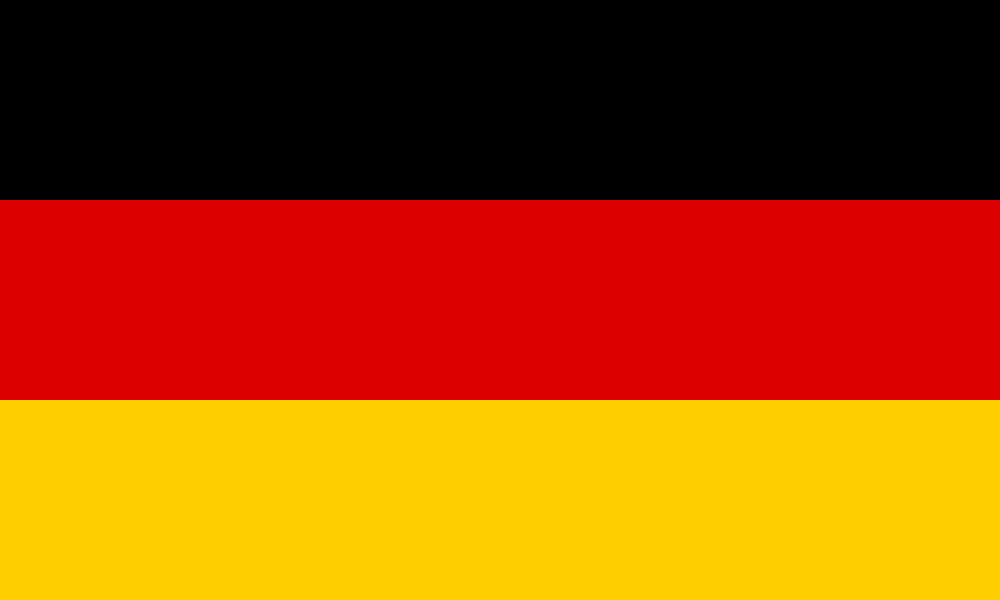
 Germany
Quick answerGermany is a country in Western Europe, with a population of 83,467,117 (2025). Its capital is Berlin, its official language is German, and its currency is the Euro (EUR). It covers 357,114 square kilometres (137,882 square miles), and its time zone is Europe/Berlin.
Germany is the most populous country in the European Union, home to about 83.5 million people. Its capital is Berlin, its official language is German, and its currency is the euro.
Key facts
| Capital | Berlin |
|---|---|
| Population | 83,467,117 (2025) · 83.5 million |
| Population density | 238.9 people per km² (land area) |
| Area | 357,114 km² (137,882 sq mi) total · 349,390 km² (134,900 sq mi) land |
| Official language | German (official) |
| Currency | Euro (EUR, €) |
| Time zone | Europe/Berlin |
| Government | Federal parliamentary republic |
| Coastline | 2,389 km |
| Highest point | Zugspitze, 2,962 m |
| Life expectancy | 80.8 years (2024) |
| Calling code | +49 |
| Driving side | Right |
| Internet domain | .de |
Overview
Germany sits in the heart of Europe, bordered by nine countries: Denmark to the north, Poland and the Czech Republic to the east, Austria and Switzerland to the south, and France, Luxembourg, Belgium and the Netherlands to the west, with coastlines on the North Sea and the Baltic Sea. It covers 357,114 square kilometres, making it the seventh-largest country in Europe by area. The land rises from the flat North German Plain through forested central uplands to the Bavarian Alps in the south, where the Zugspitze reaches 2,962 metres. The Rhine, Elbe and Danube are its great rivers, and its 2,389 kilometres of coastline face two seas.
About 83.5 million people lived in Germany at the end of 2025, according to the Federal Statistical Office (Destatis), making it the most populous country in the European Union and the second most populous in Europe after Russia. Most Germans live in cities and towns: about 82 per cent of the population is urban. Berlin, the capital, anchors a metropolitan region of around 6.2 million people, while the Rhine-Ruhr area around Cologne, Düsseldorf and Essen is one of the largest urban agglomerations in Europe. German is the official language, and life expectancy at birth was 80.8 years in 2024.
Germany is a federal parliamentary republic made up of 16 states, known as Länder. The chancellor heads the government, and the president is head of state. The country was a founding member of the European Union and is a member of NATO and the G7. Its economy, worth about $4.7 trillion in 2024, is the largest in Europe and the third largest in the world, built on manufacturing — cars, machinery and chemicals — as well as services and exports. Germany is known for its engineering, its car makers, its beer and bread, its classical composers such as Bach and Beethoven, and its writers and philosophers. It is also home to 55 UNESCO World Heritage sites, the third-highest number of any country, from the cathedrals of Cologne and Aachen to the old towns of Lübeck and Bamberg.
Notable facts
- Germany is the most populous country in the European Union, with 83,467,117 people at the end of 2025, according to Destatis.
- Germany shares land borders with nine countries — more than any other European country except Russia: Denmark, Poland, the Czech Republic, Austria, Switzerland, France, Luxembourg, Belgium and the Netherlands.
- The Zugspitze, at 2,962 metres, is the highest point in Germany and in the Bavarian Alps.
- Germany has 55 UNESCO World Heritage sites, the third-highest number of any country in the world.
- Life expectancy at birth in Germany was 80.8 years in 2024, according to the World Bank.
How Germany compares
Comparison table — Germany next to 3 similar countries (neighbours first, then the same subregion).
| Country | Population | Area | Density | Capital |
|---|---|---|---|---|
| Germany ★ | 83,467,117 (2025) | 357,114 km² | 238.9 people per km² | Berlin |
| France | 68,720,337 (2025) | 551,695 km² | 126.3 people per km² | Paris |
| Monaco | 38,857 (2025) | 2.084 km² | 18645.4 people per km² | Monaco |
| Australia | 27,801,023 (2025) | 7,692,024 km² | 3.6 people per km² | Canberra |
Cities in Germany
- Berlin 3,700,577 people (2025) · Capital Known for Brandenburg Gate
- Hamburg 1,973,896 people (2024) Known for Port of Hamburg
- Munich 1,505,036 people (2025) Known for Oktoberfest
- Cologne 1,025,523 people (2025) Known for Cologne Cathedral
Frequently asked questions
What is the capital of Germany?
The capital of Germany is Berlin. It is also the country's largest city, with about 3.7 million people inside the city limits (December 2025) and around 6.2 million in the wider Berlin-Brandenburg metropolitan region. Berlin sits on the River Spree in north-eastern Germany and is home to the Brandenburg Gate, the Reichstag and the Berlin Wall Memorial.
What is the population of Germany?
Germany had a population of 83,467,117 at the end of 2025, according to the Federal Statistical Office (Destatis). That makes it the most populous country in the European Union and the second most populous in Europe after Russia. About 82 per cent of Germans live in cities and towns.
What language is spoken in Germany?
German is the official language of Germany and is spoken by almost everyone in the country. It is the language of government, schools and the media. Several minority languages are also recognised, including Danish, Sorbian, Frisian, Low German and Romani, mainly in the north and east of the country.
What currency is used in Germany?
Germany uses the euro (EUR, symbol €). Germany adopted the euro in 1999 for electronic payments and in 2002 for cash, replacing the Deutsche Mark. The euro is shared by 20 European Union countries, so the same currency works across much of Europe.
Where is Germany?
Germany is in Central and Western Europe, between the North Sea and the Baltic Sea to the north and the Alps to the south. It borders Denmark to the north, Poland and the Czech Republic to the east, Austria and Switzerland to the south, and France, Luxembourg, Belgium and the Netherlands to the west.
What time zone is Germany in?
Germany uses Central European Time (CET, UTC+1) in winter and Central European Summer Time (CEST, UTC+2) from the last Sunday in March to the last Sunday in October. The IANA time zone name is Europe/Berlin. Germany has a single time zone across the whole country.
Quick quiz
Three questions from the facts on this page. No sign-up, no score is saved.
Keep exploring
- Berlin — capital of Germany
- Hamburg — city in Germany
- Munich — city in Germany
- Cologne — city in Germany
- Denmark — neighbouring country (page coming soon)
- Poland — neighbouring country (page coming soon)
- Czechia — neighbouring country (page coming soon)
- Austria — neighbouring country (page coming soon)
- Switzerland — neighbouring country (page coming soon)
- France — neighbouring country
- Luxembourg — neighbouring country (page coming soon)
- Belgium — neighbouring country (page coming soon)
- Netherlands — neighbouring country (page coming soon)
- Albert Einstein — German science figure
- Ludwig van Beethoven — German music figure
- “I will seize fate by the throat; it shall certainly never wholly overcome me.” — quote by Ludwig van Beethoven
- “Imagination is more important than knowledge.” — quote by Albert Einstein
- Monaco — another country in Western Europe
- All countries — the full list
Sources & last updated
- Wikipedia — Germany
- Federal Statistical Office of Germany (Destatis) — Current population
- World Bank, World Development Indicators
- mledoze/countries (skeleton: area, borders, capital, languages, currency, demonym, calling code, landlocked, coordinates, region, tld)
- Wikipedia — List of countries by length of coastline
- Wikipedia — List of countries and dependencies by area
- Wikipedia — Geography of Germany
- Destatis — GDP key table (IMF World Economic Outlook)
Last updated: . Figures are shown with their year; where sources disagree, the value is left out rather than estimated.